Containerized Odoo Tenancy: How We Isolate 100+ Instances Safely
True multi-tenancy in 2026 isn't about sharing resources—it's about sharing the control plane while isolating the data. Here is how JengaStack secures client databases.
When you’re building a managed ERP platform, the most critical question isn’t “how many features can we add?” but “how safe is my neighbor?”
In a traditional multi-tenant application, users share a single database and a single application process. If one user triggers a memory leak or exploits a code vulnerability, everyone suffers.
At JengaStack, we rejected the shared-process model. Instead, we use Strict Containerized Isolation. Here is a look at the architecture that allows us to run hundreds of Odoo instances on a single cluster without them ever knowing the others exist.
The Isolation Hierarchy
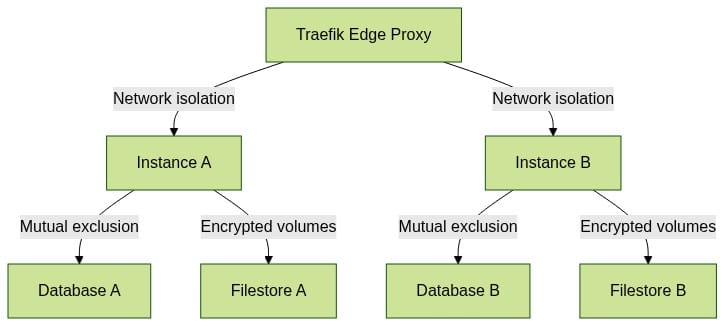
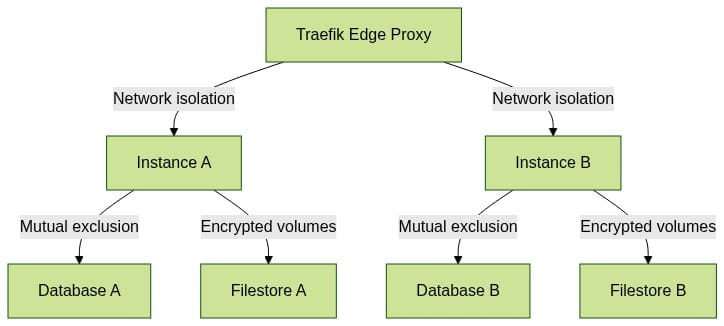
We isolate at three distinct layers: Network, Filesystem, and Compute.
1. Network: The Traefik Barrier
Each Odoo instance lives on its own internal Docker network. There is no “east-west” traffic allowed between customer containers.
The only way into an instance is through Traefik, our edge proxy. Traefik handles:
- SSL Termination: Automatic Let’s Encrypt certificates per subdomain.
- Path Routing: Directing
client-a.jengastack.appto the specific internal container hash. - Middleware Security: Rate limiting and header sanitization before the request even touches Odoo.
2. Filesystem: Atomic Volumes
Odoo stores attachments (PDFs, images) on the disk. In a shared environment, a misconfigured script could theoretically read another user’s files.
We solve this by mapping each instance to a unique, encrypted directory on the host:
volumes:
  - /mnt/data/tenants/client_a/filestore:/var/lib/odoo/filestore
  - /mnt/data/tenants/client_a/config:/etc/odoo
By the time the Odoo process starts, it only “sees” its own slice of the world.
3. Compute: Resource Quotas
One client running a massive report shouldn’t crash the server for everyone else. We use Docker deploy limits to enforce hard caps on CPU and RAM:
deploy:
  resources:
    limits:
      cpus: '0.5'
      memory: 1G
The Architecture Diagram
Why Not Just Use "Odoo Multi-DB"?
Odoo has a built-in "Multi-Database" mode. It’s great for a single company with three branches. It is dangerous for a SaaS.
- The Global Lock: One long-running SQL query can lock the entire Postgres process.
- Shared Modules: If one database requires a custom module, it must be available to all databases in that process.
By containerizing the entire Odoo process (Python + Addons) per customer, we allow every client to have their own specific module set and own performance profile.
Final Thought
True multi-tenancy in 2026 isn’t about sharing resources—it’s about sharing the control plane while isolating the data.
It’s more work to build, but it’s the only way to sleep soundly at 2 a.m. knowing that a spike in "Client A" will never become an outage for "Client B."
Stop sharing processes. Start isolating value.