You Don’t Need a $100 Cloud Bill to Build a Real SaaS
We’ve quietly accepted that spending $100/month on infra before you have a single customer is normal. It shouldn't be. Here is how to build a production-ready SaaS on a $5 VPS.

We’ve quietly accepted something strange in modern web development:
Spending $100/month on infrastructure before you have a single customer is considered normal.
It shouldn’t be.
If you follow the average “build a SaaS” tutorial today, this is what happens on Day 1:
- Frontend hosting (Vercel / Netlify): $20/month
- Database (Neon / Supabase): Free → $25/month
- Auth (Clerk / Auth0): Free tier → per-user pricing
- Redis / cron / queues: Usage-based
Before validation.
Before revenue.
Before your first Stripe payment.
You’re already burning $50–$100/month.
For funded startups, this is noise.
For solo developers and indie builders, it’s pressure—and pressure kills good ideas early.
So I asked a boring but important question:
What does a real, production-ready SaaS actually need?
The answer is uncomfortable:
Far less than we’ve been told.
The Constraint That Changes Everything
Instead of optimizing for infinite scale, I optimized for:
- One server
- Predictable costs
- No per-user fees
- No vendor lock-in
- Easy debugging at 2 a.m.
That single constraint changes every architectural decision.
The result is a fully functional, production-ready SaaS running comfortably on a single $5 VPS.
And in many cases—it’s faster than the cloud.
High-Level Architecture

No magic platforms.
No proprietary services.
Everything replaceable.
SQLite, On Purpose
We’ve been trained to believe that “production” means a managed Postgres cluster.
Most SaaS apps don’t need one.
SQLite in WAL (Write-Ahead Logging) mode provides:
- Zero network latency
- No connection limits
- Extremely fast reads
- Reliable writes for most SaaS workloads
When your application and database live on the same NVMe disk, query latency drops from 40–60ms (cloud database) to sub-millisecond.
What About Data Loss?
That’s the real concern—and it’s valid.
The fix is straightforward:
- Continuous replication to object storage
- Point-in-time restores
- Fast recovery on a new VPS
Your server is disposable.
Your data is not.
Authentication Without the Tax
Most applications need:
- Secure sessions
- OAuth (Google, GitHub, etc.)
- Password resets
Not an identity SaaS.
Good, production-grade options include:
- Better Auth
- Auth.js
- Authentik
- Keycloak (if you need enterprise IAM)
The key principle is simple:
Authentication data lives in your database, not a third-party tenant.
No per-user pricing.
No lock-in.
No surprise invoices when you grow.
Deployment: Containers Over Platforms
Everything runs in Docker:
- The application
- Background workers
- Monitoring tools
Once the system is defined in a docker-compose.yml, deployment becomes boring:
- Push code
- Build image
- Pull on server
- Restart container
Boring is good.
Boring is reliable.
Optional Convenience: Self-Hosted PaaS
If you want a smoother developer experience without giving up control:
- Coolify
- Dokploy
They provide:
- Git-based deployments
- Environment variables
- Rollbacks
- SSL automation
All running on infrastructure you own.
Observability Without Enterprise Bills
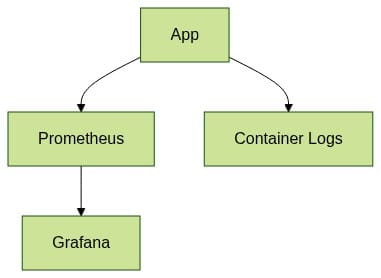
With Prometheus and Grafana, you can monitor:
- CPU and memory usage
- Request latency
- Error rates
- Database performance
You don’t need Datadog to know when your app is unhealthy.
Why This Matters
This isn’t just about saving money.
It’s about runway.
When your SaaS costs $5/month:
- You can wait for product–market fit
- You can experiment freely
- You can run multiple projects on one server
- You’re not forced to monetize prematurely
When it costs $100/month:
- Every quiet month feels like failure
- Decisions become rushed
- Good ideas get killed too early
High infrastructure costs don’t just burn cash—they distort judgment.
Final Thought
You don’t need:
- A hyperscaler
- A dozen managed services
- A massive cloud budget
You need:
- One Linux server
- A boring, well-understood stack
- And the courage to own your infrastructure
Scale when it’s real.
Optimize when it hurts.
Until then—
stop renting complexity.