Orchestration at Scale: Why We Chose Komodo Over Kubernetes
Kubernetes is the industry standard, but for most startups, it's a suicide pact. Here is why we chose Komodo—a lightweight, Docker-driven orchestrator—for JengaStack.
In the SaaS world, there is a recurring trap that technical founders fall into:
“We’ll build it on Kubernetes now so we don’t have to migrate when we hit a million users.”
It sounds responsible. It sounds like forward-thinking engineering.
In reality, for most startups, it’s a suicide pact.
When we started building JengaStack, we needed to manage hundreds of isolated Odoo instances. Each instance has its own database, its own set of modules, and its own backup schedule.
The “industry standard” answer is Kubernetes (K8s).
We said no.
Instead, we chose Komodo—a lightweight, Docker-driven orchestrator. Here is why choosing “boring” tech was the best decision we made for our customers and our sanity.
The Complexity Tax
Kubernetes is a masterpiece of engineering, but it comes with a massive “Complexity Tax.”
To run a simple multi-tenant Odoo stack on K8s, you need:
- A managed K8s cluster ($$$)
- Ingress controllers
- Cert-manager
- Persistent Volume Claims (PVCs)
- Complexity in networking (LoadBalancer vs NodePort)
For a startup, this means you spend 40% of your time managing the platform and 60% building the product.
With Komodo, we reduced that tax to near zero.
Why Komodo?
Komodo acts as a control plane for Docker. It doesn’t try to reinvent the wheel. It just makes the wheel spin faster and more reliably.
1. Minimal Overhead
Our architecture runs on standard Ubuntu VMs. We don’t need a massive control plane consuming 4GB of RAM just to stay alive. This allows us to pass those savings directly to our customers.
2. Predictable State
Odoo is stateful. It loves its filesystem and its Postgres database. Kubernetes’ ephemeral nature makes stateful apps a headache to manage. Komodo treats Docker Compose files as the source of truth, making deployments predictable and easy to debug at 2 a.m.
3. Native Speed
By staying close to the metal (or at least the Docker daemon), our provisioning time for a new Odoo instance is under 30 seconds. No waiting for pods to pull images across a complex mesh.
The JengaStack Way
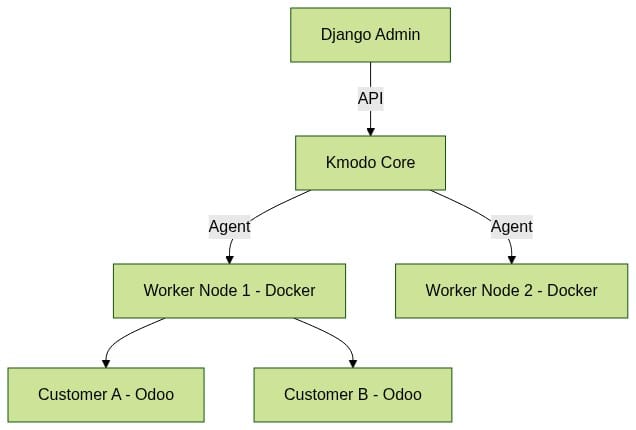
Our orchestration stack looks like this:
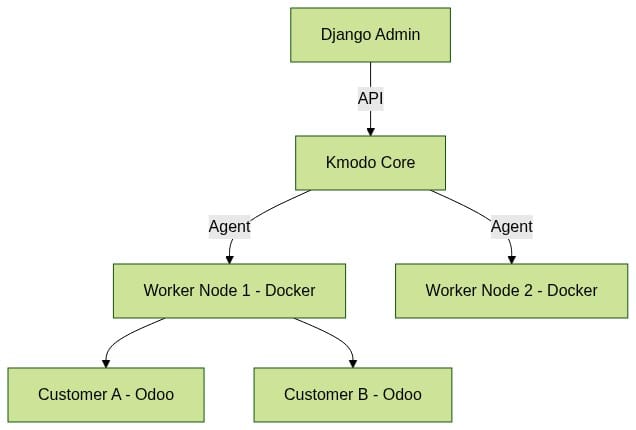
It’s boring. It’s simple. And it scales horizontally just by adding more worker nodes.
Stop Renting Complexity
Most applications don’t need “infinite scale.” They need reliability, speed, and low costs.
By choosing Komodo over Kubernetes, we avoided:
- The “Cloud Bill” shock.
- The steep learning curve for our team.
- The fragility of complex networking layers.
We optimized for the Kenyan SME reality: an ERP that is fast, compliant, and doesn’t break.
If you’re building a SaaS today, ask yourself: Are you solving a customer problem, or are you just playing with expensive Lego sets?
Until next time—
Stop renting complexity. Start building value.